10,000 Lux Light: Is Your Lamp Really That Bright?
A 10,000 lux light reaches 10,000 only at one distance, sometimes 6 inches. How to check your therapy lamp with a phone, how long to sit, and what to fix.
6 min read. Updated November 18, 2026.

LightMeter Pro: Lux Meter for iPhone
Open the app, aim the camera, and get a live lux, foot-candle, EV and Kelvin reading. In Plant mode pick the light source and the hours, and read PPFD and DLI on the spot.

Free to download. Plans and offers are shown in the store.
The app is in English.
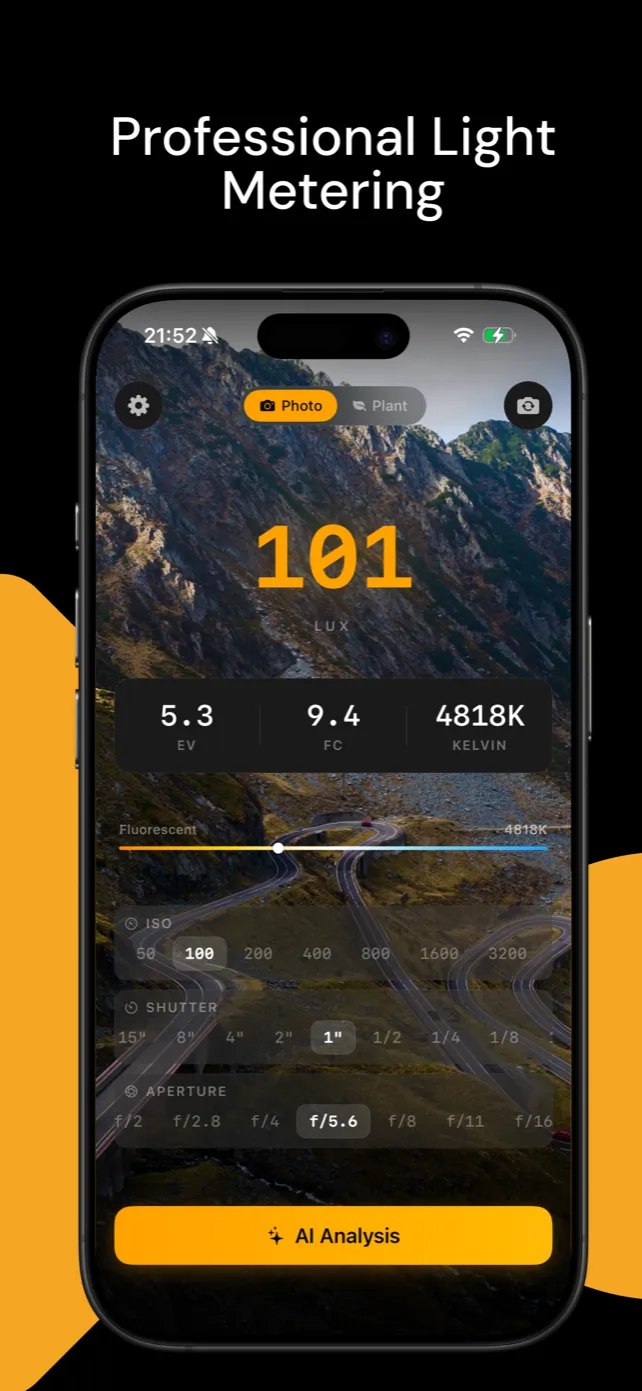
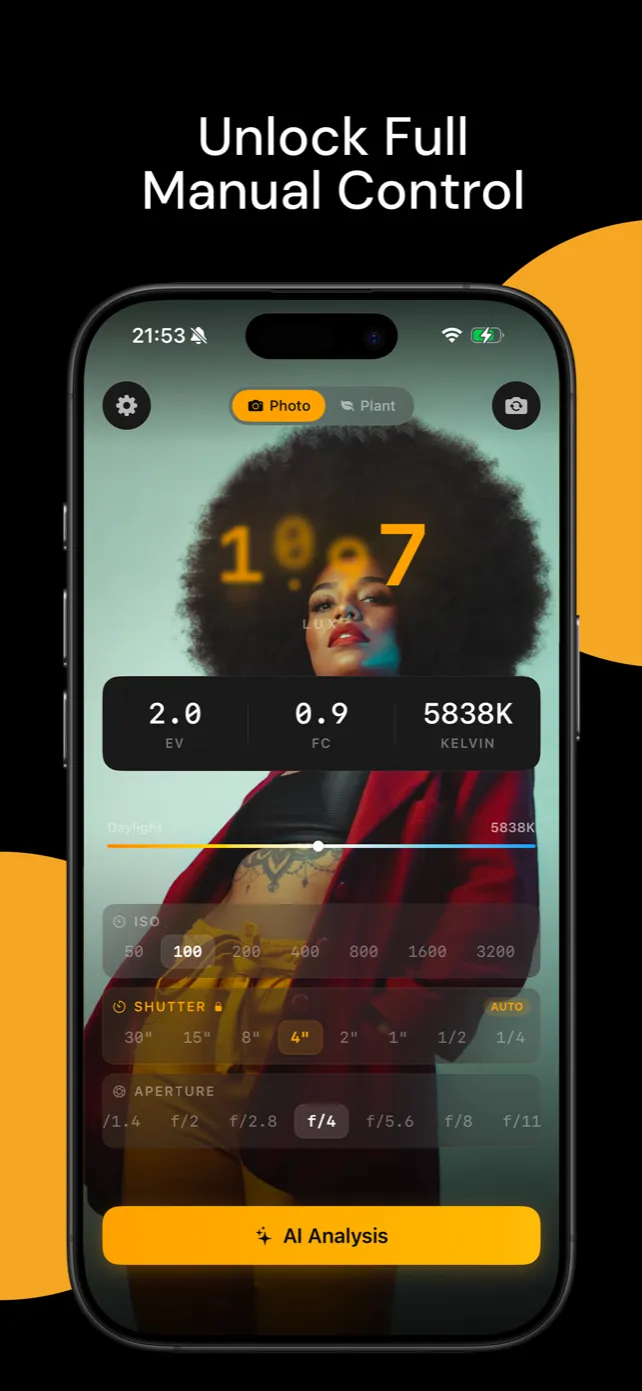
Aim the camera and read the light in real time: lux or foot-candles, exposure value, and colour temperature in Kelvin with a warm to cool bar. Tap a point to meter it, switch between front and rear camera.
Switch to Plant mode, pick the light source (sunlight, LED, HPS or fluorescent) and read PPFD in µmol/m²/s. Set the photoperiod from 4 to 24 hours and the app gives the daily light integral.
Set ISO, shutter speed and aperture in standard full stops, lock one value and let the others solve from the reading, like a handheld meter.
Point at a scene, pick a scenario such as Portrait, Product, Interview or Cinematic, and get the scene type, the lighting quality, mood tags and three to five concrete ways to improve the setup.
A dark interface with a live viewfinder, haptic feedback and no ads.
Plans and offers can differ between the App Store and Google Play, and are shown in the store before you subscribe.
A 10,000 lux light reaches 10,000 only at one distance, sometimes 6 inches. How to check your therapy lamp with a phone, how long to sit, and what to fix.
6 min read. Updated November 18, 2026.
Shutter speed at double the frame rate: 1/50 s for 24 fps, 1/60 for 30, 1/125 for 60. The chart, shutter angles, flicker-free settings and the ND you need.
6 min read. Updated November 18, 2026.
Photone, myLightMeter, Lightme, LM-3000, Lux Light Meter and more compared with prices as of November 2026, plus when a Sekonic or PAR meter is worth it.
6 min read. Updated November 18, 2026.
Bright indirect light is about 200 to 800 foot-candles (2,000 to 8,600 lux) with no sun on the leaves. Where to find it, examples and the shadow test.
5 min read. Updated November 18, 2026.
A PPFD meter counts the photons plants use. When a phone lux reading with the right factor is enough, when a quantum sensor pays off, how to calibrate.
5 min read. Updated November 18, 2026.
The exposure triangle in plain numbers: how aperture, shutter speed and ISO each change brightness by stops, what each costs, and four worked examples.
6 min read. Updated November 18, 2026.
An EV chart from starlight to snow in full sun, with the matching lux and foot-candles, settings at f/2.8, f/8 and f/16, and how to adjust for your ISO.
5 min read. Updated November 18, 2026.
Convert foot-candles to lux by multiplying by 10.764, or divide to go back. Tables both ways, a mental shortcut, and who still works in foot-candles.
5 min read. Updated November 18, 2026.
How dark your room should be for sleep: under 1 lux at the eye in bed and about 10 to 30 lux in the 3 hours before. The research and how to check.
6 min read. Updated November 18, 2026.
Seedlings 4 to 6 inches under LED strips, foliage plants 12 to 24 inches, panels 12 to 36 inches by wattage. Charts by light and stage, plus target PPFD.
6 min read. Updated November 18, 2026.
Indoor herbs need a DLI of 10 to 25 mol: 4 to 8 hours of sun or 12 to 16 hours under a lamp. Targets for mint, parsley, cilantro, thyme and basil.
4 min read. Updated November 18, 2026.
Most houseplants grow at 100 to 500 foot-candles. The four light bands in lux and fc, DLI targets, a table for 25 plants and how to measure your spot.
8 min read. Updated November 18, 2026.
Seedlings need 100 to 300 PPFD for 14 to 18 hours, a DLI of about 6 to 15. Targets by week, lamp distance, and why a windowsill gives leggy seedlings.
5 min read. Updated November 18, 2026.
Succulents need 800+ foot-candles (8,600+ lux) and 4 to 6 hours of sun to stay compact. Stretch signs, window spots and grow light settings that work.
4 min read. Updated November 18, 2026.
A bird of paradise needs 500 to 1,000 foot-candles (5,400 to 10,800 lux) and 4 to 6 hours of sun to flower. Window spots, leaf signs and grow lights.
4 min read. Updated November 18, 2026.
A Boston fern grows at 100 to 300 foot-candles (1,100 to 3,200 lux) with no harsh sun. Where to hang it, light vs humidity signs and grow light settings.
3 min read. Updated November 18, 2026.
A desert cactus needs 1,000+ foot-candles (10,800+ lux) and 6 to 8 hours of direct sun. Etiolation signs, sunburn, holiday cacti and grow light settings.
4 min read. Updated November 18, 2026.
A calathea grows at 200 to 400 foot-candles (2,200 to 4,300 lux) with almost no direct sun. Why it fades, curling vs light signs and grow light tips.
3 min read. Updated November 18, 2026.
A fiddle leaf fig needs 400 to 800 foot-candles (4,300 to 8,600 lux) and 3 to 4 hours of sun once adjusted. Placement, leaf-drop signs and grow lights.
4 min read. Updated November 18, 2026.
A jade plant needs 400 to 800 foot-candles (4,300 to 8,600 lux) plus 3 to 4 hours of sun. Signs of a leggy jade, window spots and grow light settings.
3 min read. Updated November 18, 2026.
A money tree grows best at 200 to 400 foot-candles (2,200 to 4,300 lux) with an hour or two of morning sun. Where to put it, signs and grow light settings.
4 min read. Updated November 18, 2026.
A monstera grows well at 200 to 400 foot-candles (2,200 to 4,300 lux) with 2 to 3 hours of soft sun. Window spots, signs and grow light settings.
4 min read. Updated November 18, 2026.
A peace lily keeps its leaves at 100 to 200 foot-candles (1,100 to 2,200 lux) and flowers at 200 to 400 fc. Where to put it, signs and grow light settings.
4 min read. Updated November 18, 2026.
Most philodendrons grow at 100 to 300 foot-candles (1,100 to 3,200 lux); Pink Princess and other coloured types want 300 to 500. Spots, signs, lamps.
3 min read. Updated November 18, 2026.
A pothos grows at 100 to 200 foot-candles (1,100 to 2,200 lux) and survives near 50 fc. How light shapes its vines and colours, spots and grow lights.
3 min read. Updated November 18, 2026.
A prayer plant grows best at 200 to 400 foot-candles (2,200 to 4,300 lux) with little direct sun. Light and its folding leaves, signs and grow lights.
3 min read. Updated November 18, 2026.
A rubber plant grows best at 400 to 800 foot-candles (4,300 to 8,600 lux) and copes at 150. Light by variety, where to put it and grow light settings.
4 min read. Updated November 18, 2026.
A snake plant grows at 100 to 200 foot-candles (1,100 to 2,200 lux), survives far less and handles 5 to 6 hours of sun. Spots, signs and grow light tips.
4 min read. Updated November 18, 2026.
A spider plant grows best at 200 to 400 foot-candles (2,200 to 4,300 lux). How light changes its stripes and runners, where to put it and grow lights.
4 min read. Updated November 18, 2026.
String of pearls needs 400 to 800 foot-candles (4,300 to 8,600 lux) and 2 to 4 hours of soft sun. Bald tops, spaced pearls, placement and grow lights.
3 min read. Updated November 18, 2026.
Tomatoes need a DLI of 20 to 30 mol to fruit: 8+ hours of sun or 350 to 500 PPFD for 16 hours. Compact types, seedling light and the 18-hour limit.
4 min read. Updated November 18, 2026.
A ZZ plant grows at 100 to 200 foot-candles (1,100 to 2,200 lux) and holds on near 50 fc. Where it thrives, signs of too little light and grow lights.
3 min read. Updated November 18, 2026.
Aloe vera needs 400 to 800 foot-candles (4,300 to 8,600 lux) and 4 to 6 hours of sun indoors. Floppy leaves, red stress colour and grow light settings.
3 min read. Updated November 18, 2026.
African violets bloom at 400 to 800 foot-candles (4,300 to 8,600 lux) with 14 to 16 hours under a lamp. Leaf signs, window spots and shelf light settings.
3 min read. Updated November 18, 2026.
An alocasia grows at 200 to 400 foot-candles (2,200 to 4,300 lux) with an hour or two of soft sun. Leaf drop, winter dormancy, placement, grow lights.
4 min read. Updated November 18, 2026.
A moth orchid needs 200 to 400 foot-candles to stay healthy and about 1,000 fc of filtered light to rebloom. Lux targets, leaf colour test and grow lights.
4 min read. Updated November 18, 2026.
Basil needs a daily light integral of 13 to 25 mol: 6 to 8 hours of sun or a grow light for 14 to 16 hours. PPFD targets, lamp height, leggy signs.
3 min read. Updated November 18, 2026.
How to measure lux at a desk, in a room or by a lamp: where to hold the sensor, the paper trick for phones, four-point averages and a quick calibration.
6 min read. Updated November 18, 2026.
Incident meters read the light falling on a subject, reflected meters read what bounces off it. Why snow turns grey, what 18% grey means, and which to use.
6 min read. Updated November 18, 2026.
What lab tests and side-by-side photo checks found on phone light meter apps, why 113% error is just one stop, and how to calibrate yours in ten minutes.
5 min read. Updated November 18, 2026.
A window loses most of its light within a few feet. What north, east, south and west windows give plants, the shadow test, and how to measure in lux.
5 min read. Updated November 18, 2026.
What a light meter measures, the five types from handheld dome to phone app, how to use one in six steps, and the fixes for snow, shade and backlight.
7 min read. Updated November 18, 2026.
Low light means 25 to 100 foot-candles, about 270 to 1,075 lux. 20 low light plants that cope, the floor for each, and how far from each window.
6 min read. Updated November 18, 2026.
Lumens vs lux in plain words: lumens are the light a bulb sends out, lux is the light that lands on your desk. Formulas, candela, watts and Kelvin.
6 min read. Updated November 18, 2026.
Recommended lux levels for every room and task, from 50 lux on stairs to 500 lux at a desk, with the standard behind each number and how to check yours.
7 min read. Updated November 18, 2026.
Convert lux to lumens with one formula: lumens = lux x area in square metres. Worked examples for bedrooms, kitchens and desks, plus the margin to add.
5 min read. Updated November 18, 2026.
Multiply lux by 0.0185 for sunlight, 0.014 to 0.018 for white LEDs, 0.012 to 0.013 for HPS. The full factor table, why lux is not PPFD, examples.
5 min read. Updated November 18, 2026.
Measure plant light with an iPhone in two minutes: where to hold it, the white-paper trick, lux to foot-candles and PPFD, and a log sheet for your spots.
6 min read. Updated November 18, 2026.
Why film needs more time than the meter says past 1 second, with the makers' corrections for HP5 Plus, FP4, Delta, Tri-X, T-MAX, Portra, Velvia and Provia.
7 min read. Updated November 18, 2026.
Sunny 16: f/16 at 1/ISO in direct sun. The full chart from snow to open shade, equivalent settings at ISO 100 and 400, and when you still need a meter.
5 min read. Updated November 18, 2026.
DLI is the total plant light a spot gets in a day, in mol/m²/day. How to calculate it from PPFD and hours, and DLI targets for houseplants and crops.
5 min read. Updated November 18, 2026.
LightMeter Pro is an iPhone light meter. It reads lux, foot-candles, EV and colour temperature from the camera, converts the reading to PPFD and DLI for plants, solves exposure settings for photographers and analyses a scene's lighting with AI.
Yes. Plant mode turns the reading into PPFD for sunlight, LED, HPS or fluorescent light, and into DLI once you set how many hours the light is on. Compare the numbers with the plant targets on this site.
A phone reads light through its camera, so treat the number as a good estimate rather than a lab value. Measure at the same spot and angle each time and the readings are consistent enough to compare places, lamps and times of day.
It meters reflected light through the camera, like an in-camera meter. Set ISO, shutter and aperture in full stops, lock one and the app solves the others from the live EV.
It is free to download with live metering, Plant mode and a few AI scene analyses a day. Pro unlocks unlimited AI analysis and the shutter and aperture locks. Plans and offers are shown in the store.
No. LightMeter Pro is an iPhone app.
Your light, measured. Lux, EV and PPFD from the phone in your pocket.
LightMeter Pro is made by EASYTECH, an independent app studio in Annecy, France. Privacy policy · Terms of use. For iPhone.